



“Pittsburgh’s Job Market: Low Unemployment With Emerging Pressures
Pittsburgh’s labor market remains historically tight even as some national indicators cool, with the metro’s seasonally adjusted unemployment rate steady at 3.9% in August 2025 and payrolls up 1.4% year-over-year, driven primarily by education and health services. For Upper St. Clair employers, continued tightness suggests sustained competition for talent into Q4, especially in clinical, educational, and technical roles central to the region’s “eds and meds” and advanced tech strengths.
The Numbers Behind the Narrative
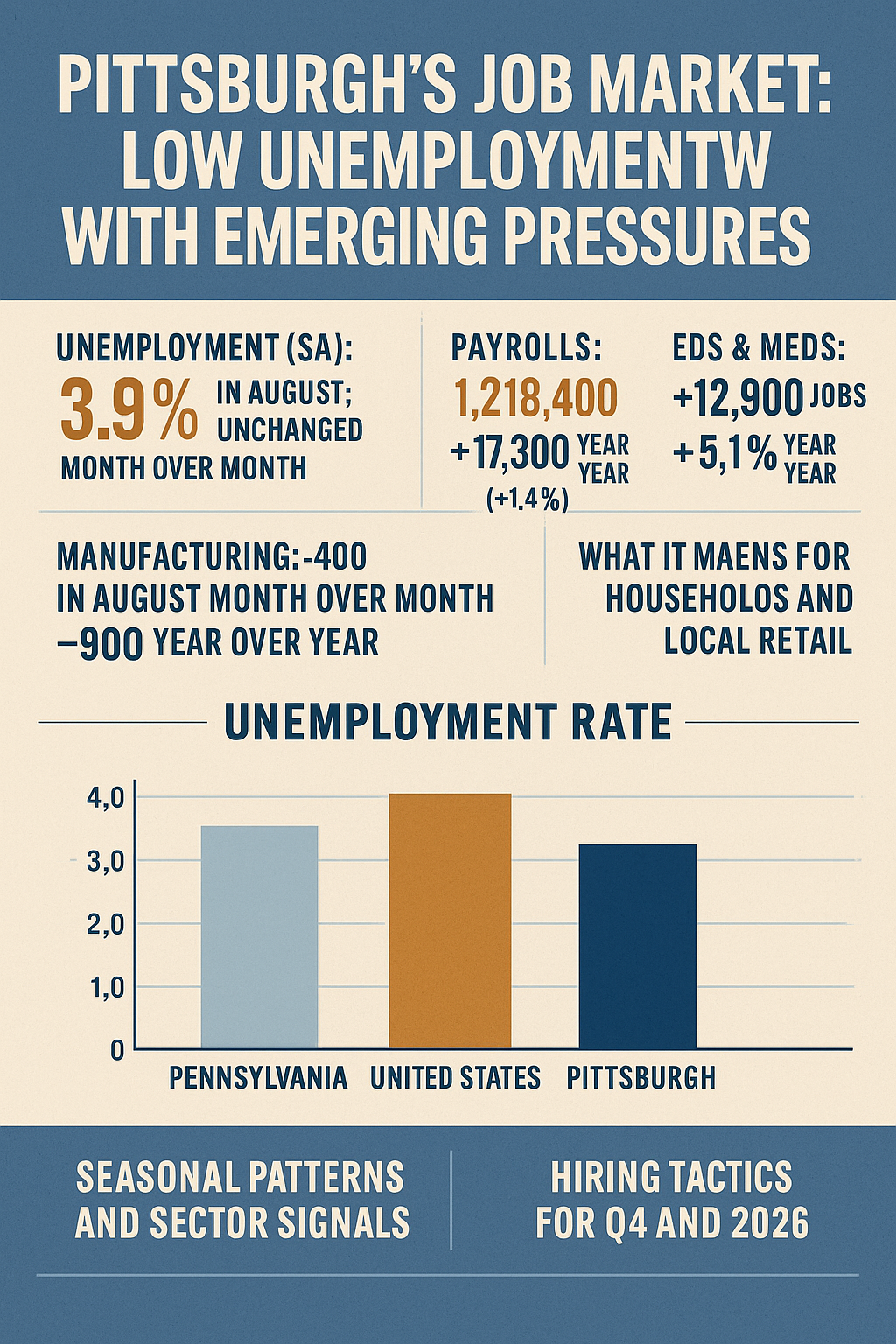
State labor authorities report the Pittsburgh MSA added 1,800 jobs in August to 1,218,400, capping a year-over-year increase of 17,300 jobs (+1.4%) despite seasonally soft summer months for schools and government. Education and health services posted the most significant annual gains, at +12,900 (+5.1%), highlighting the enduring pull of hospitals and universities. Meanwhile, manufacturing showed a net decline of 900 jobs year over year amid broader sectoral headwinds. The state’s August release confirmed Pennsylvania’s unemployment rate at 4.0% and the U.S. rate at 4.3%, situating Pittsburgh modestly better than the national average.
Data callout:
Unemployment (SA): 3.9% in August; unchanged month over month.
Payrolls: 1,218,400; +17,300 year over year (+1.4%).
Eds & meds: +12,900 jobs; +5.1% year over year.
Seasonal Patterns and Sector Signals
Month-to-month declines in government (-2,000) and education/health (-1,200) reflect normal summer seasonality; durable goods added to a 400-job manufacturing uptick in August, but not enough to offset year-over-year contraction in the sector. BLS metro releases show a broad pattern of slightly higher jobless rates across many U.S. metros compared with a year earlier, underscoring that Pittsburgh’s resilience exists amid wider mixed signals. For Upper St. Clair firms, these patterns suggest cautious optimism with a need to hedge against sector-specific softness, particularly in manufacturing-adjacent supply chains.
Data callout:
Seasonal pullback: education/government typically sees summer declines.
Manufacturing: +400 in August month over month; -900 year over year.
National metro trend: more MSAs with higher jobless than a year prior.
Hiring Tactics for Q4 and 2026
A tight market favors employers who expand their pipelines—through apprenticeships with regional institutions, upskilling current staff, and tapping return-to-work cohorts—while addressing wage compression and retention risks. Planning should incorporate longer time-to-fill, flexible schedules, and productivity enhancements via process improvements and tech adoption, especially for professional services and healthcare. With statewide job openings at record highs and Pittsburgh’s unemployment rate still low, hiring managers should lock in job offers decisively while preparing for variable demand tied to consumer sentiment and mortgage rate trends.
Data callout:
State context: Pennsylvania unemployment 4.0% in August.
Record jobs streak: statewide gains continue through August.
Strategy: training and retention to offset the tight supply.
What It Means for Households and Local Retail
Stable employment supports household spending across the South Hills, though inflation-sensitive categories remain under scrutiny and could temper discretionary outlays into the holidays. If mortgage rates continue easing from midyear highs, housing-related spending—from furnishings to home services—may lift local retailers, but inventory and affordability constraints remain a check on volumes. For Upper St. Clair, the base case is steady labor market support, with sectoral caution flags that merit careful inventory and staffing management.